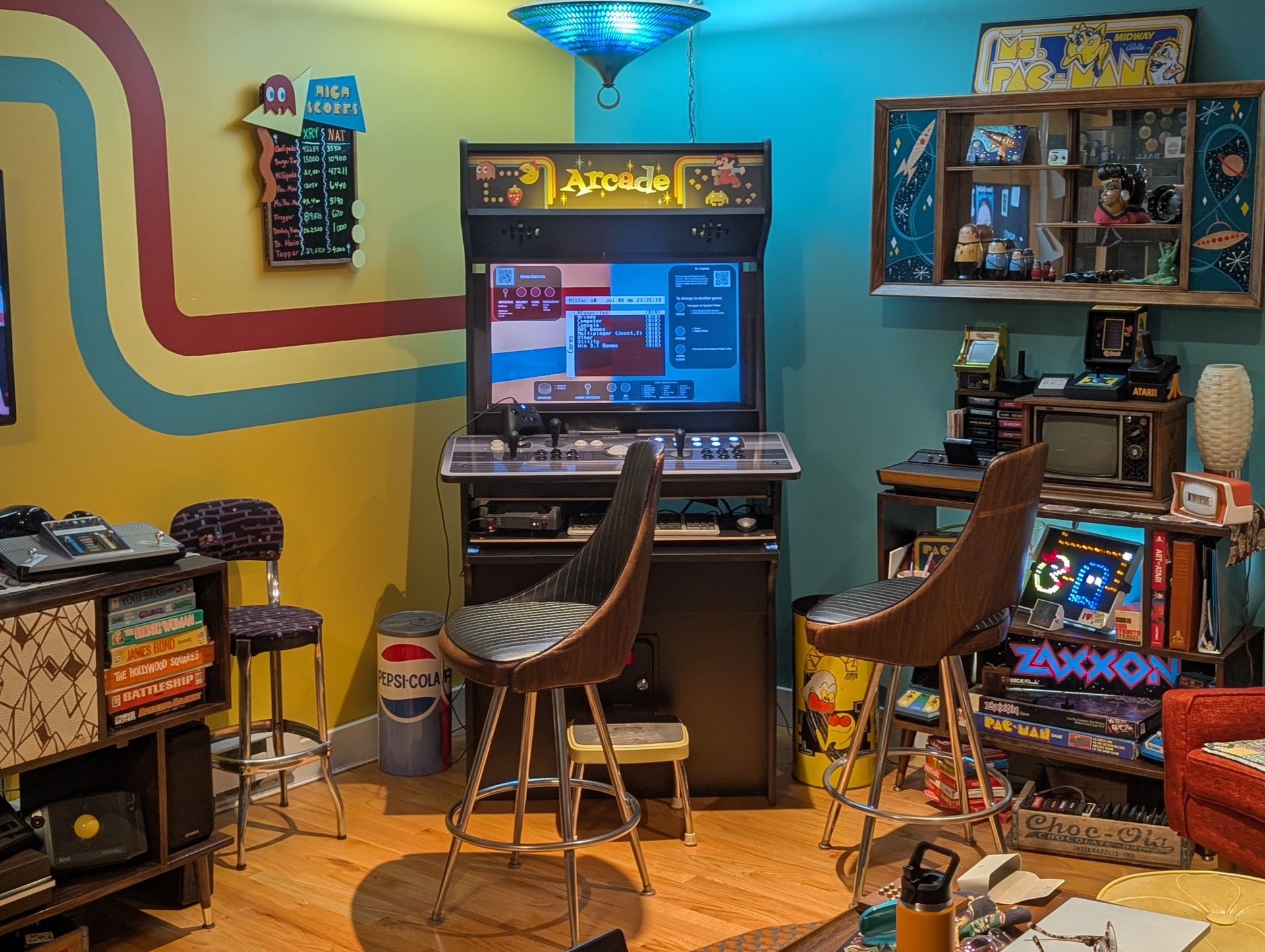
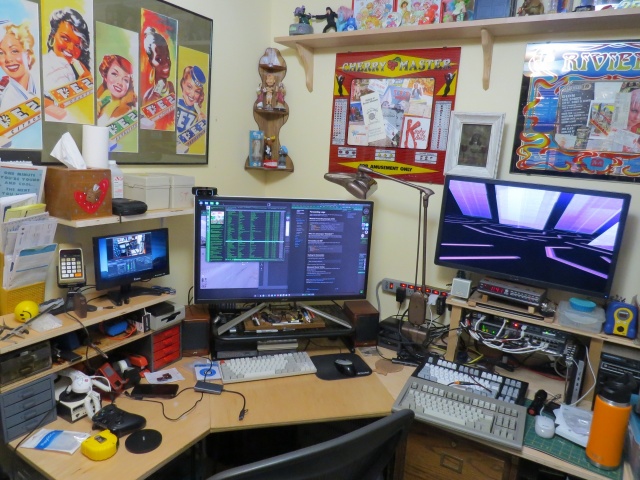
I would pay the MiSTer project money and jump in and help in any way I can to help with a "Lite Mode" UI that could be quickly picked up by say, a house guest with their only instruction being on-screen or physical info-graphics.
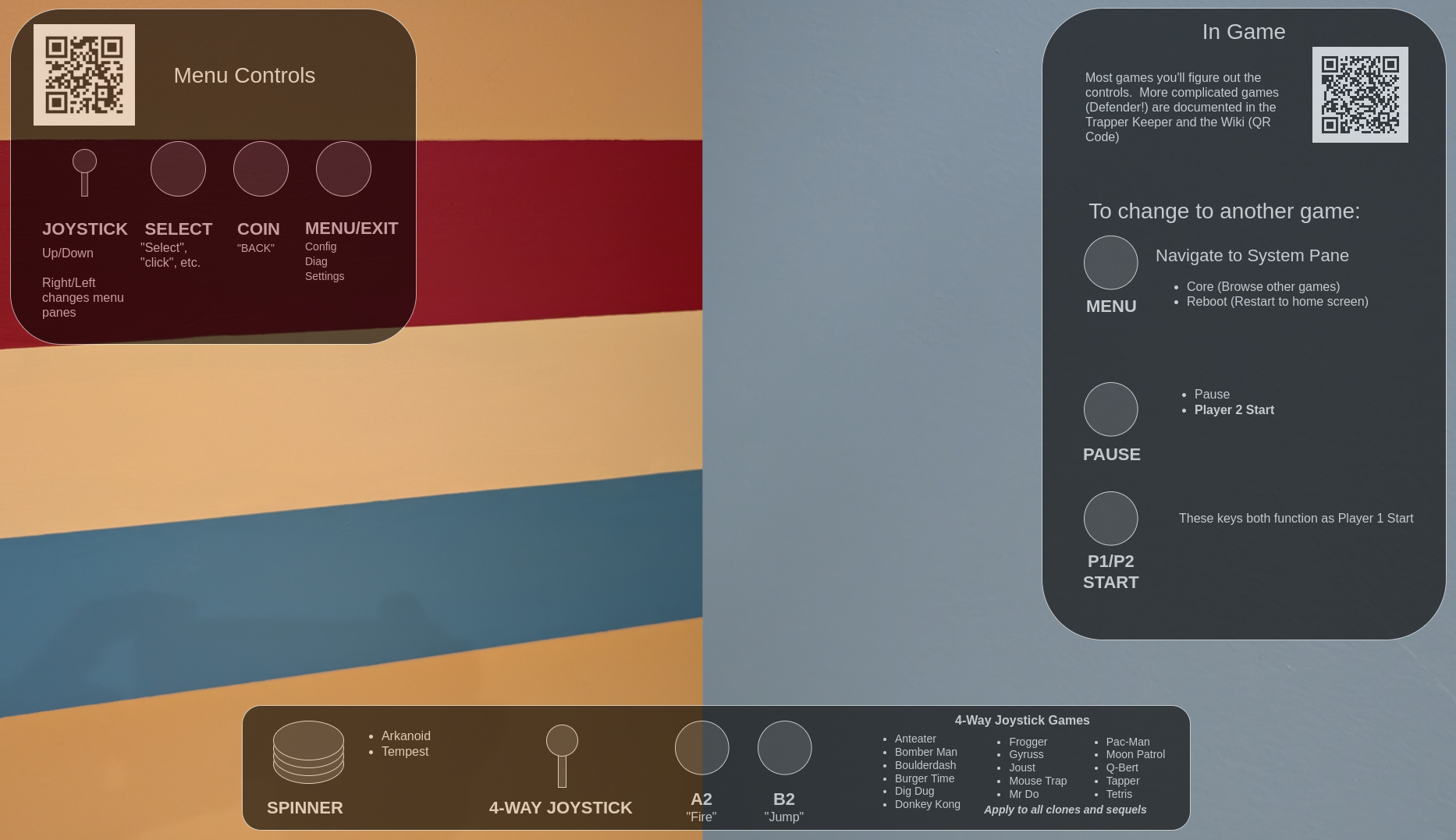
To that end, I'm making an arcade-cabinet-bezel inspired custom background overlay with basic "how to navigate" with QR code links to my Wiki for a little more detail if the user needs more specific info.
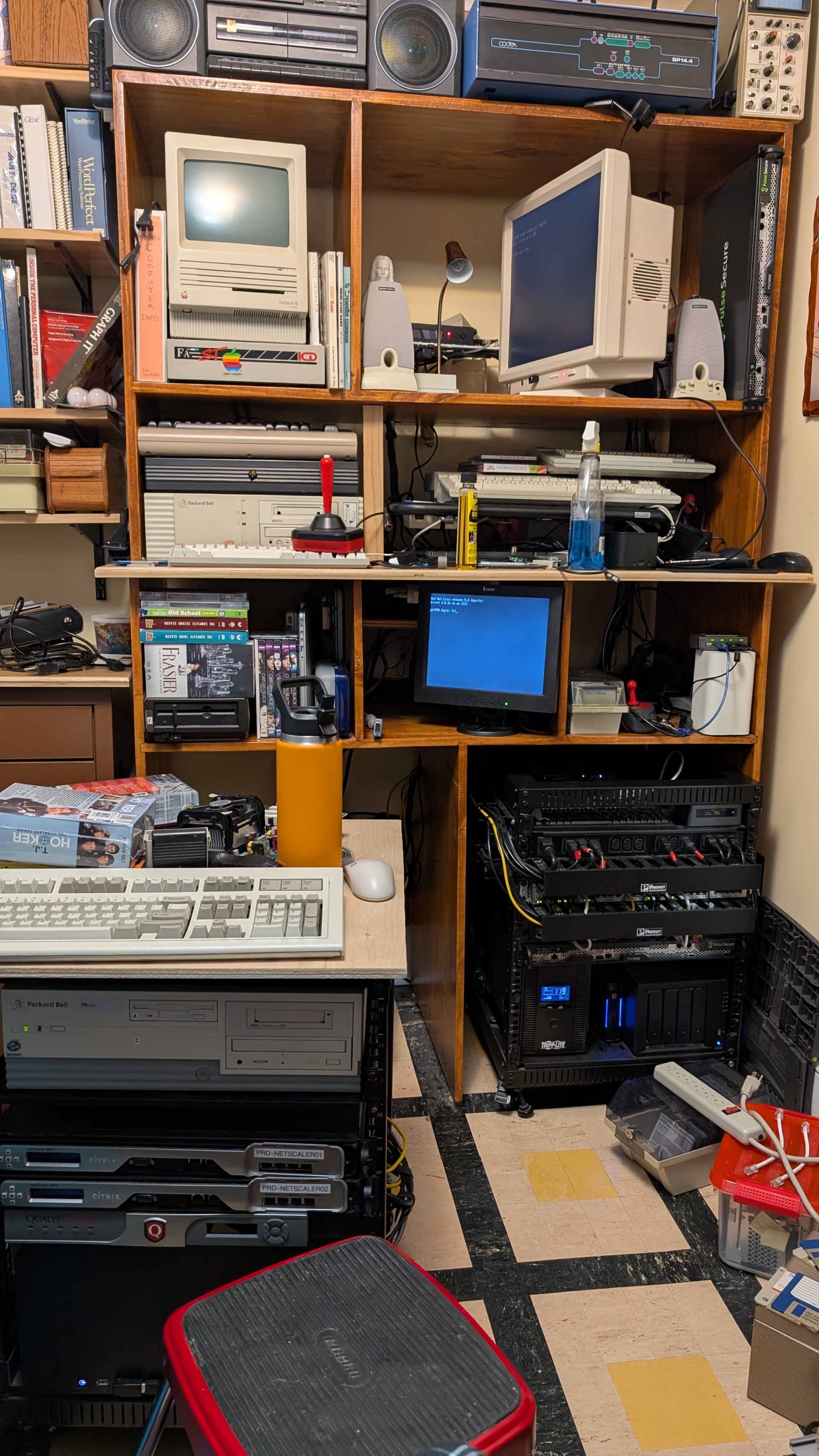
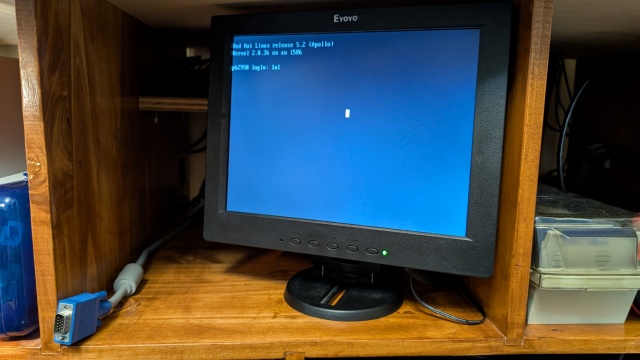
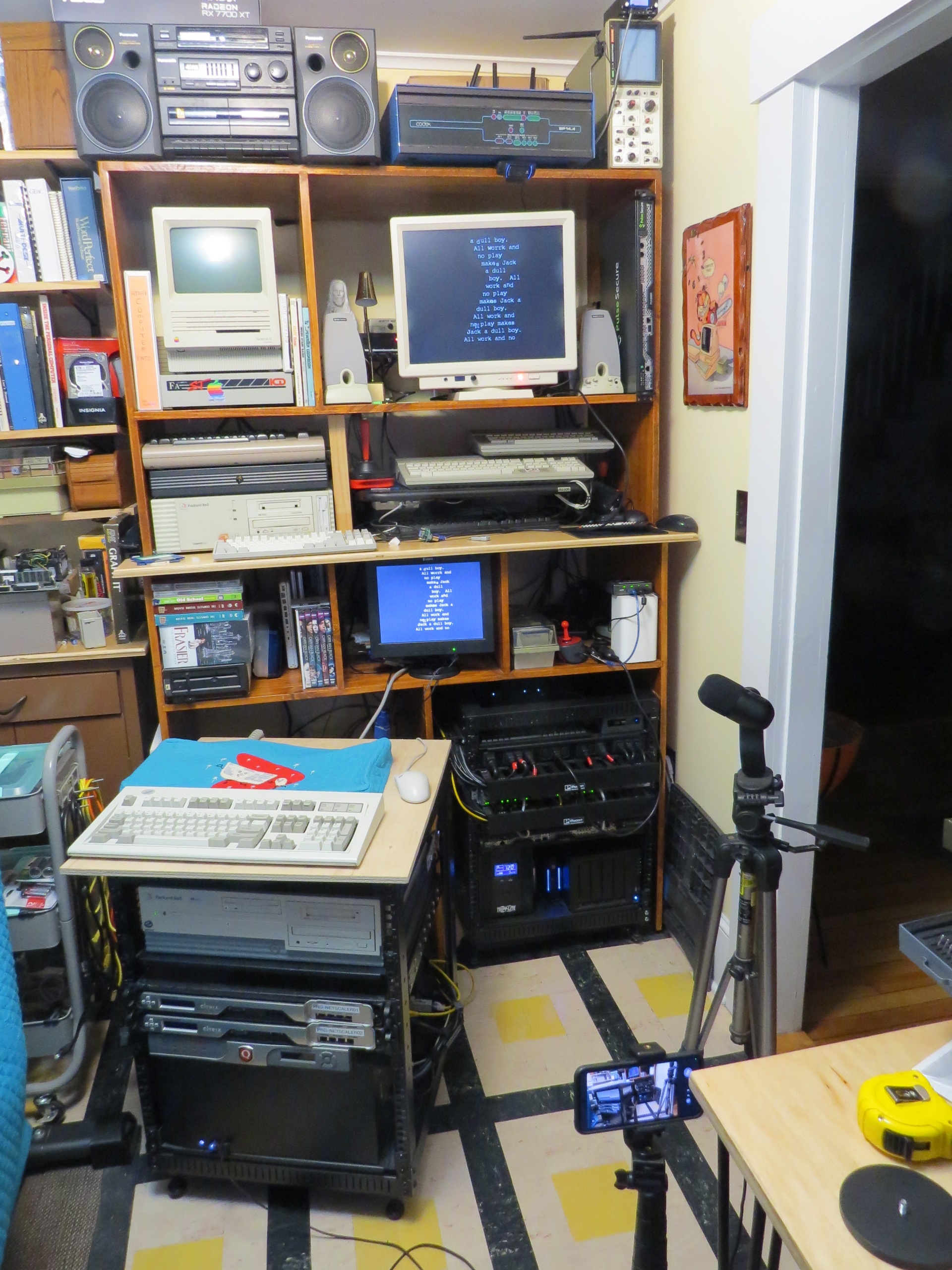
To give myself a visually consistent target I took two photos and crammed them together and have been meaning to share the result:
This effect really only works from very specific spots, but one of them happens to be "Standing at the controls".
The current running test is below. I've already got a list of things to change and yeah I promise the first thing is to remove my phone :
There's a healthy and well adjusted use of my resources, and then there's whatever I'm doing here.
This video is also a test of a new microphone. It failed. Sorry about the choppiness, I don't really know what's going on there.
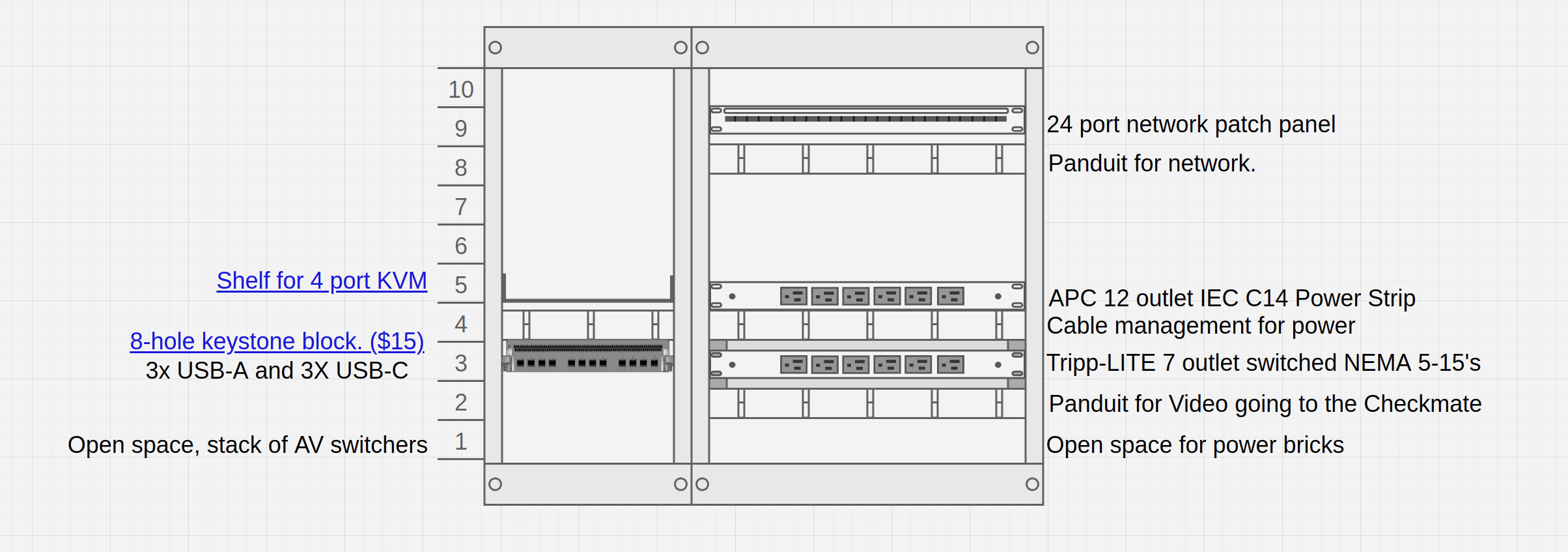
Here's the sketch of where things are going to go. There's lots of empty space for pegboard and other accessories over time:
Also I mention the Avocent but never really explain what that is so here's my page on that. It's a serial port concentrator so I can manage a bunch of stuff over serial:
Here's the 30 second beer ad commercial for this monitor.
I can plug in every single machine I own and switch between them all with a remote. In basically two days I built a full isolation network mini-rack build right into the monitor chassis to allow seamless administration of an untusted network with Windows 95 and RedHat 5.2, NeXT, Mac all wanting file sharing service, name services, software and driver repos. That's all done. I can just grab drivers on my workstation, drop them right into a file share and pick them up on a Windows 95 machine. And I have loose VGA connections ready to go to configure servers and stuff that have VGA out. All that VGA video is going through two, passive $25 VGA switchboxes. Looks super sharp, and I was the guy with the 17" and 21" Sonys (as pictured below!). My big Trinitrons also just had tons of this switchbox stuff going on and never looked this good. I mean, chalk it up to better cables I guess, but I very purposely bought the "Standard '90s Beige Switcher" with the big chunky knob and yeah it just looks perfect.
Not only all that, but you can capture the screen through the crystal clear HDMI output.
I'm pretty sure streaming is a main intended feature of this monitor, but even for me, where that's not my primary use for this thing, it's so convenient. I can sit here in a Secure As I Can Make It VNC connection to a Windows 95 machine and capturing what's on the screen across the room in OBS. I find myself instinctively just watching progress on the display in OBS rather than turn all the way around just to see if my 57MB has copied over its 10Mb Ethernet yet.
Neat Indeed.
And yeah that modem is "10BASE-T" explicitly. The manual specifies Category 3, 4 or 5 UTP for 10BASE-T). This DOS only program really is how you set things like the duplex in the manual.(Not speed/duplex, multiple speeds didn't exist)
I could probably have left it at 10/Half and been just fine. I should get some 100Mb cards though. There's not gonna be a whole lot of bidirectional traffic on this thing. I mean I worked on plenty of office networks running 10BASE2 back in the mid '90s. Occasionally someone would have Novell and some twisted pair.
I thankfully got in toward the tail end of "new" 10BASE2 installs though I did my share of fishing that shit in several-hundred-year-old buildings.
SCSI also. I have like 2 bins of SCSI stuff plus enclosures I really want to build. That SCSI gear was Above My Pay Grade in 1997 when I was 22 and burning all the candles at once with a blowtorch. The Packard Bell I'm working on now is identical to the one I first played Doom on in 1994. Mine was an SX-33 that I upgraded to a Cyrix 80Mhz. This one is an Intel 50Mhz, so it's a "2052" rather than the "2033" I had. The P120 is also very age appropriate. This whole thing is basically an upscaled version of my 22-ish year-old setup.
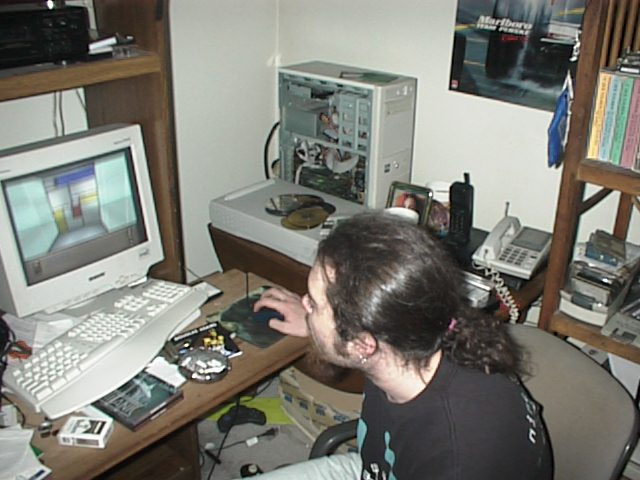
The file modified datestamp on this photo is 9/9/1999 at 10:57PM. I think that game is Obsidian, which I did pay for and did own which came out in 1997, so I'd have been between 22 and 24 there.
I'm wrong, that's Starship Titanic, which was my other guess, which came out in April 1998, and I did buy it it's on my desk there!
In my intro to the Checkmate monitor video I mentioned how I'd love to have this on a datacenter bench and maybe throw a switch in there as well. Well now I'm going to do that.
Now that I'm starting to use all these computers for more than a couple minutes once every few months it's time to build a proper isolation network. I'm beginning the process or archiving loads of Atari ST and GCR Mac floppies so I definitely want to have somewhere safe to do that work. The little Raspberry Pi 3 in my monitor will serve as the bridge, serving old and insecure protocols to that network so we can have the full '90s experience. So it's listening on Telnet and FTP to host archives of all the NeXT software ever made for instance. I'll be dialing back Samba security to the point that a Windows 3.11 or 95 machine can connect to the fileshare. The Pi will also provide the WiFi network for exciting things coming up like my FujiNet cartridge that I haven't even tried to play with yet. I will very likely move DHCP and DNS resolution from the default gateway to the Pi just so I can pick the whole thing up and take it places. Plug devices in and they'll be able to get an address and browse by hostnames and stuff.
It's so nice to have an all-in-one solution and I'm happy to stick a little PoE powered switch in the Checkmate to provide the networking for all of it. This monitor is now a "pick it up and go" solution to demo a wholly contained network of 1980s and 1990s machines where no one can hurt them. If I went to things like VCF, this is what I'd bring to run my whole table.
That monitor is going to feature in a lot of my stuff in a big way. Every time I do a project I find a new use for it! Running desktop computers through multiple VGA switch-boxes? Still looks great!
Again, sorry for the "beginner" nature of all of this but I'm playing with kdenlive and learning how to speed things up and make short clip montages, so you can watch me suffer as I learn :-) It's basically 1978 PBS, WTF do you want it fits my entire aesthetic. Look where I live.
Stay tuned to see my friction-free and more importantly secure way of interacting with all these backend systems. Coming Soon!
I've got a ton of video, all of it garbage, about making a dumb shelf and backplate for my "retro things Isolation Network" that I'm trying to get down to like 20 minutes.
I think the thing to do is watch it all through, then make notes and then go back and execute the notes rather than try to do it one at a time as individual tweaks.
To manage this I'm gonna try and use my internal Wiki with a link on the homepage to like my Blog Notes category so I can go update stuff as I watch, then check them off as I complete them.
We'll see. I just want to put up the dumb "Switch in a Monitor!" video so I can do the really cool stuff of "How I am securing this since no one else talks about this stuff.
But since I've been working on this in the last two days:
My NeXTStation started hanging at the ROM Monitor check screen. I know this has happened before and I know I changed the iSCSI image but I think the real answer was something stupider than that.
This would be a way cooler demo if I had a second machine, like say a NeXTStation which was just working awesome like 3 days ago. I think I gotta just fire up the 95 PC what am I even thinking here duh.
I just replaced my webserver hardware up to the hard drive. I suspect this thing's problems aren't hardware but you never know and it's easier than moving everything.
I dropped one of the very nice thumbscrews from the monitor while I was wrangling cables. It's in the room somewhere. But if you've ever worked in a datacenter you know that a lot of the stuff you drop is just gone into the rack somewhere and you'll never see it again.
Bonus points for nice and beefy but non-ferrous objects. So if I could hit 'em with a magnet they'd probably be super easy to find.
NeXTStation status updated to Dead. All of this has happened before, and all of this will happen again
My stupid thumb is still bleeding after cutting it on Friday. I've lived with much worse without going to a doctor don't you worry. It could probably use like a stitch or something. I should figure out how to do that.
I've updated all my tools and unit tests for the video no one ever makes about how they actually do the work of dealing with their Retro networks.
Argh. I've got so much stuff to build and I just want to get at it already instead of wasting time editing nonsense that didn't even really work out!
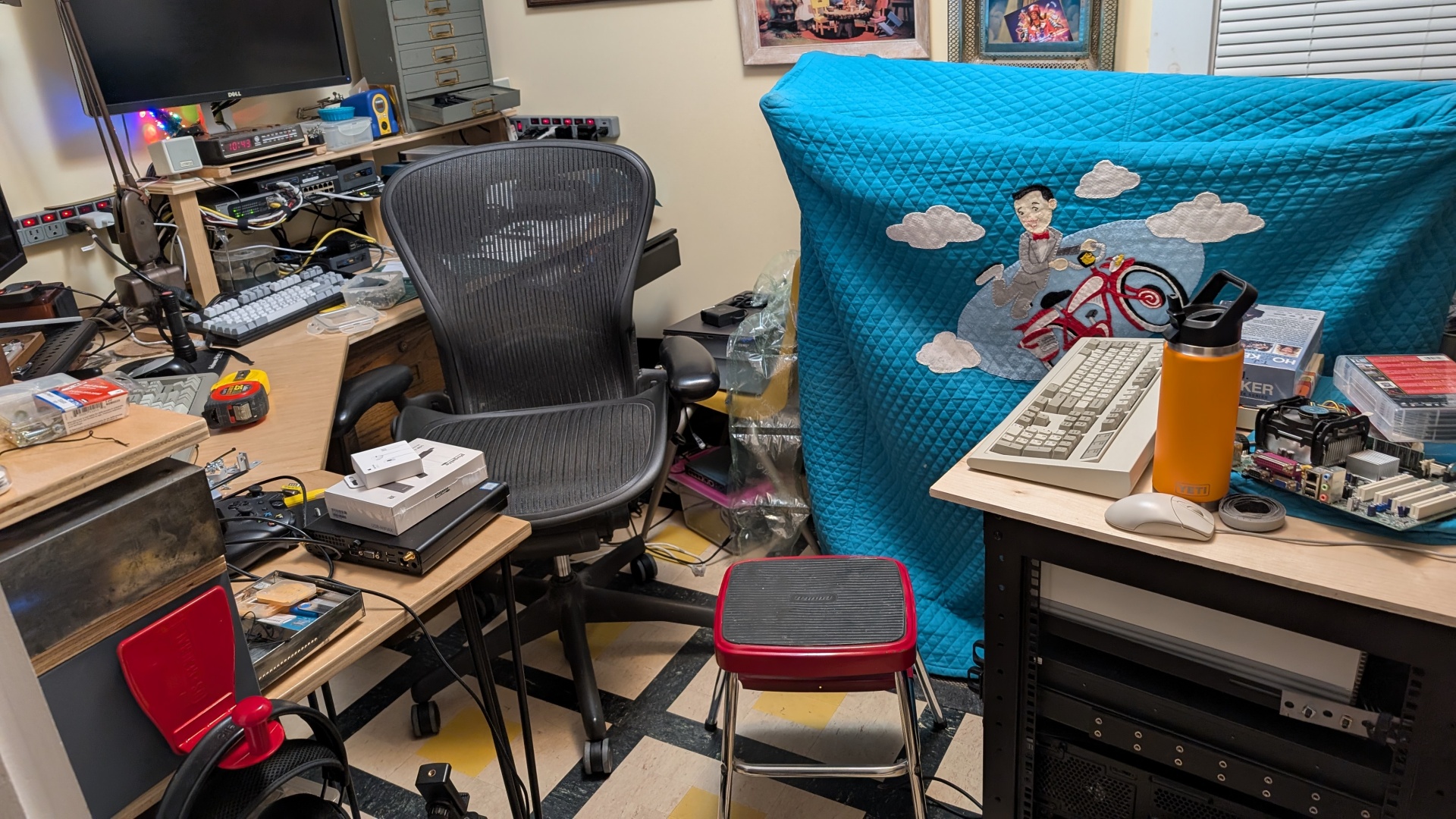
This is what it looks like when I do every single project all at once. When I do one thing, but that depends on 5 other things so it explodes the office! I love this. A person with training might call this a "manic episode" but I choose to say I'm super excited and motivated. Basically I've been sitting in this office for 10 years saying "When I have 10 minutes to think, I'm gonna...".
Well today those things were:
Re-cable the henge and fix everything ugly. That largely happened today.
Put in a shelf and clean up the mess that is this VGA switcher and cabling (NeXT + 2 PCs)
Put non-UPS in-rack power in that one rack for non-essential machines
Re-think my desk/workbench side of things and cable everything up tidily
Doesn't look tidy, but believe me it's really clean under all the mess!
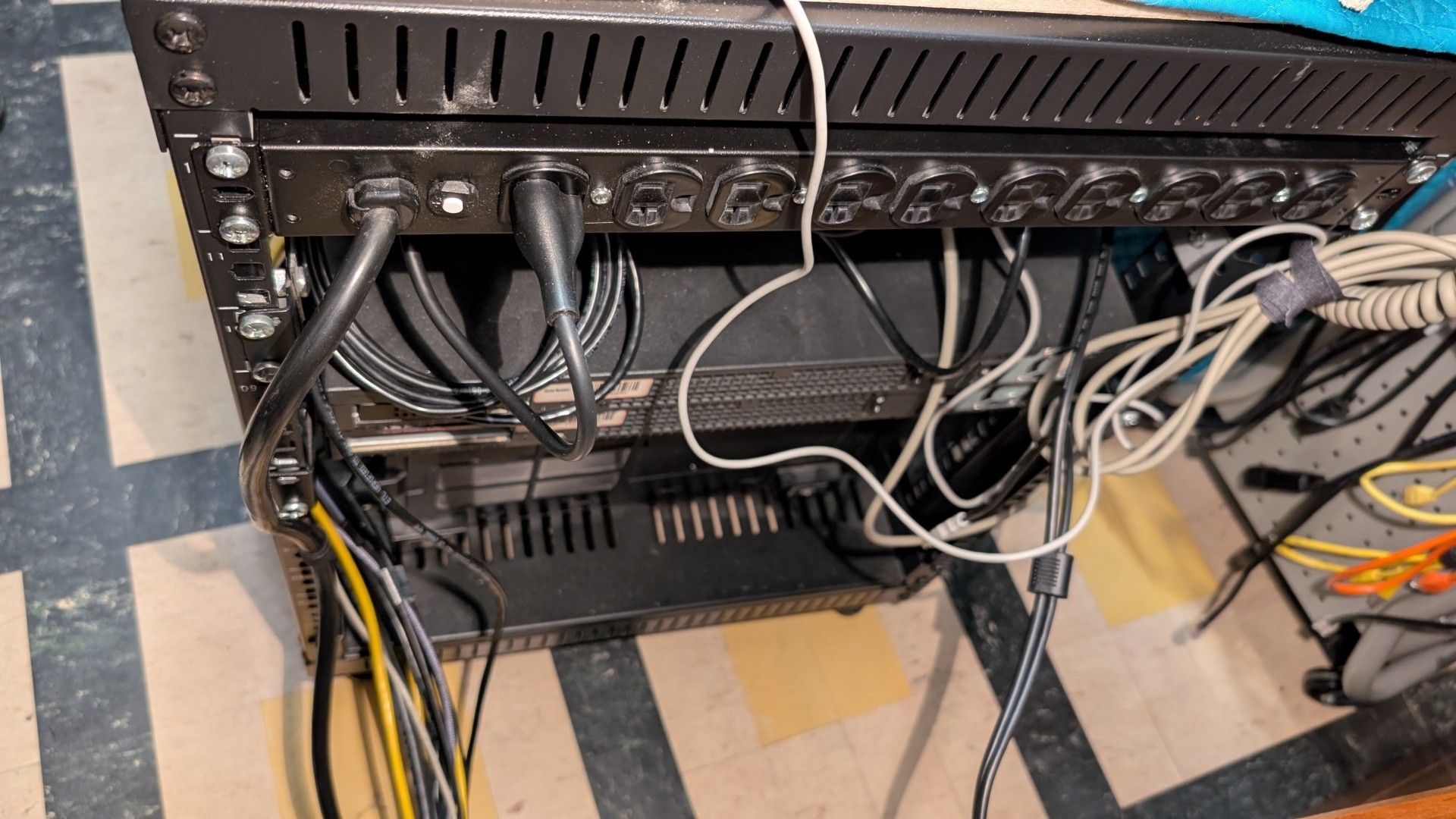
I'm going to stick some Panduit under the new power strip and tidy up all the 9' Model M cable, I'm doing a longer VGA cable right now:
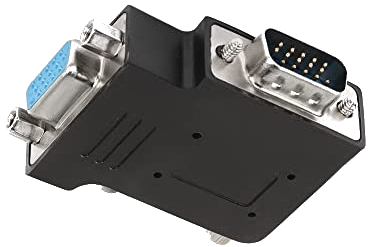
That bin in there has one of every analog A/V cable, adapter and dingus. There are lots of angled and shorter cables coming to clean that up more. The black thing is the NeXT station breakout box for VGA, sound & keyboard. The VGA cable on the left is for stuff I want to plop down and work on like a 1u server or a PC or laptop. I have two P4 PCs that I've never even powered up because doing so would be a hassle, well Hassle No More! I have a bunch of rackmount stuff to build to replace this unstable webserver. I'm going to start with one and work my way up to two servers splitting the load here.
This one might be sort of tricky. Hey Natalie, do you guys sell anything we could like taste test in the store? Maybe I should email the lighting place like what we used to do back in the before times.
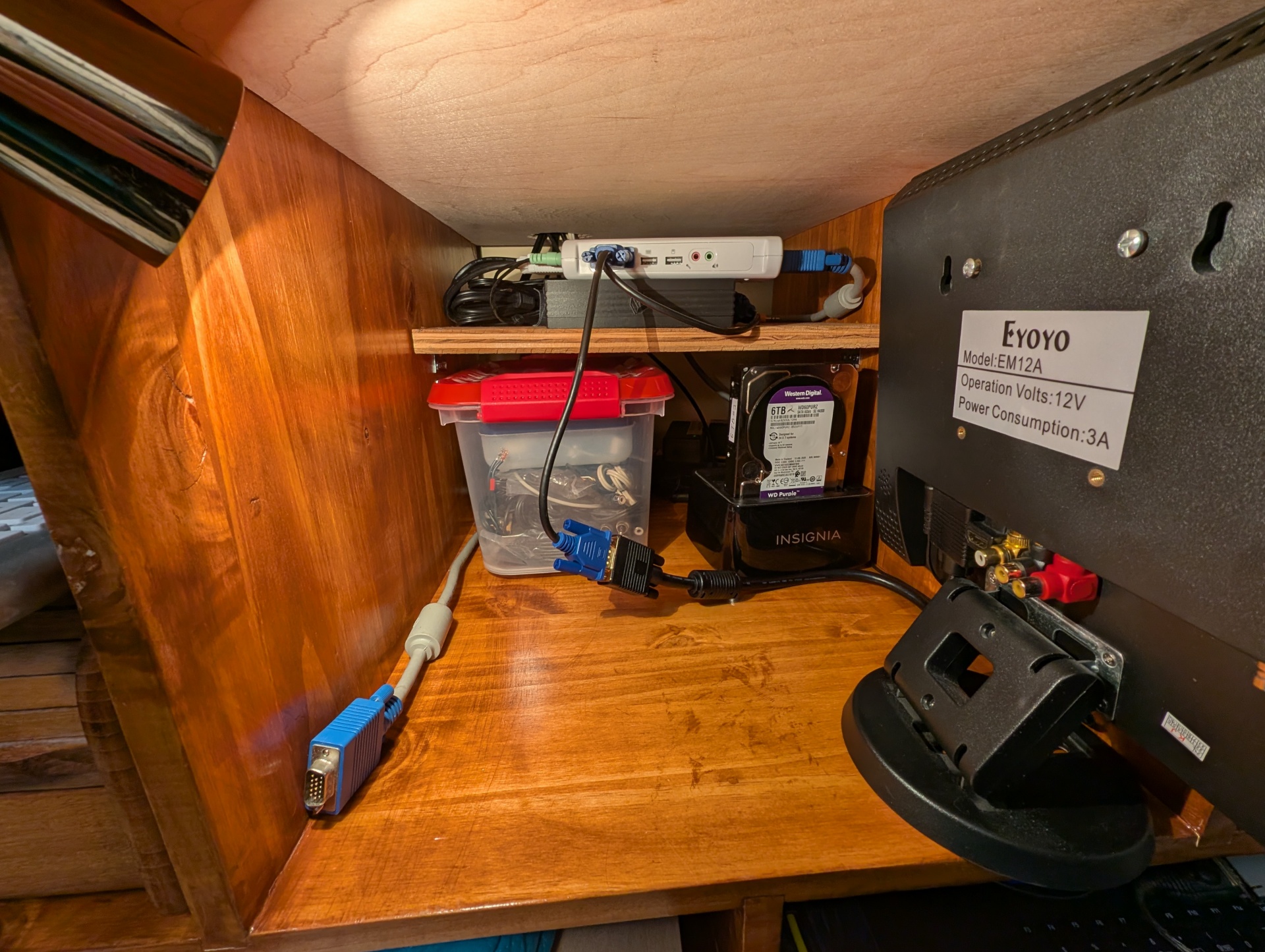
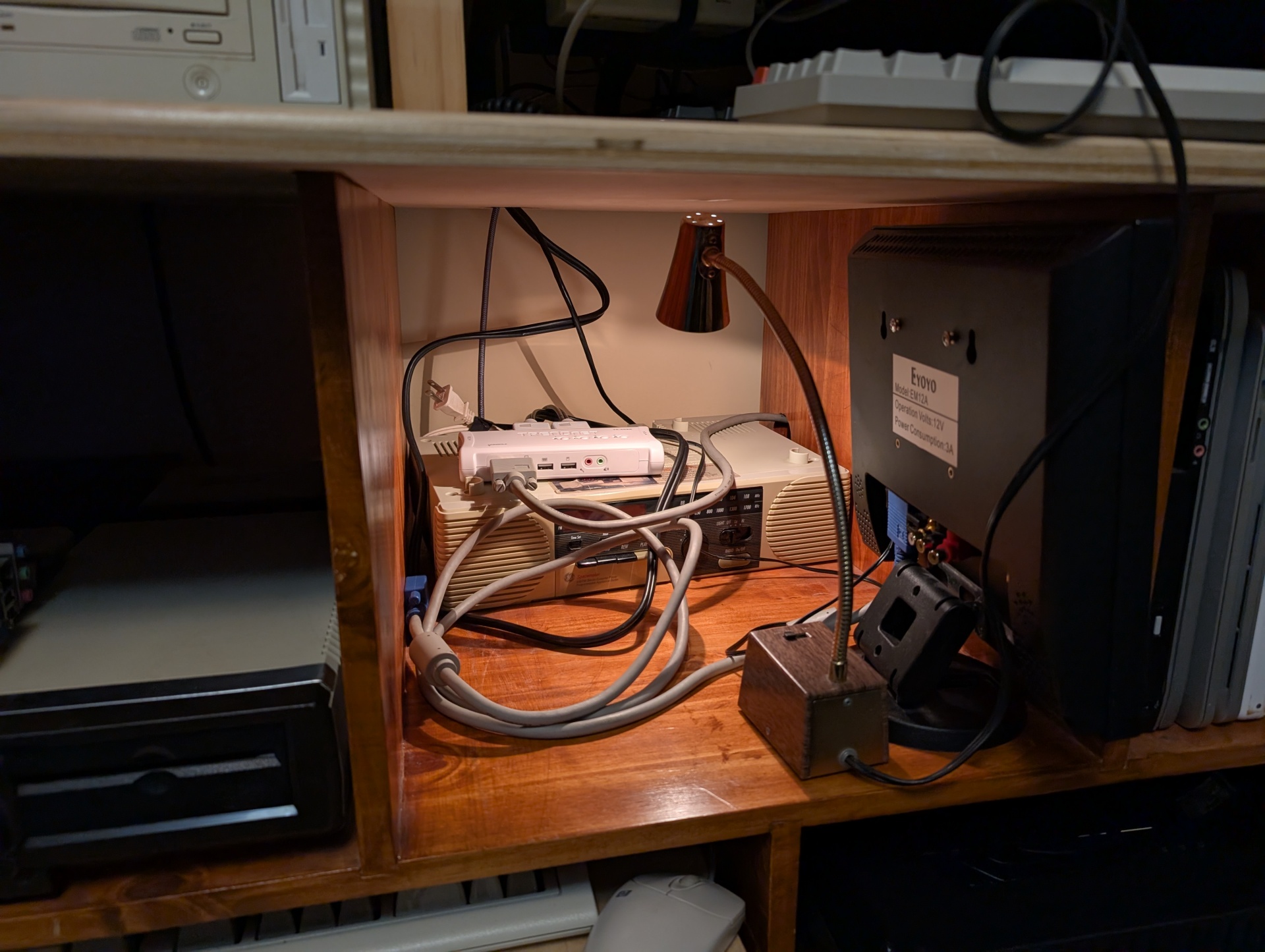
I'm building a shelf in this cubby to hold that super un-weildy VGA switcher. It's awesome but I would have paid triple the price for just 5 ports in a row rather than this octopus nonsense. It was $30, what do I want.
I need to mount that radio too, it looks super cool. I'm also going to make that the home for things like the NeXT VGA breakout box and hopefully the first USB keyboard and mouse dingus they sell. And a bin-full of adapters and "general retro-ey converters and plugs"
So I have this vintage brass and painted woodgrain gooseneck lamp which is awesome looking and so perfect for exactly what I need it for. Imagine sticking like a flashlight on its end pointing up vs this thing. But hoo man this thing's going to burn my house down like that bulb gets scalding hot within a minute or two.
These are 12V bulbs so that base has a transformer in it that gets nice and warm but gives switchable low/hi which is nice. It uses GE 1156F bulbs, which are like automotive backup lights or in a garage door opener. So I want like a modern LED equivalent that is going to look warm and nice like this thing but searching I don't think I trust buying anything I don't see with my own eyes first or someone personally vouches for. Whatever it is I'm not buying four of them for $10 without seeing them lit for real with my eyes.
I want the pleasant light qualities of a 60 year old incandescent light bulb made for one of like 2 "warm ambient light" scenarios for this bulb.
I'd pay $20 for a single bulb if I knew it was exactly what I wanted. I'm sensing a theme in this post.
Today was my last day at work, so of course I'm pulling an all-nighter working on projects and building my workflow. I don't think that will ever stop.
*I just got yelled at at 2:40am for pulling an all-nighter right now today. I'm like dude, it's my vacation, and this is me, relaxing on my goddamn vacation! I can sleep in a few days*
This is the desk I sat at for the last 5 years of my job and for two days a week for a decade before that. To be honest it feels weird for the job to be gone and for me to still be allowed in here. This is likely the last photo that will have my work laptop running Gibson in it. I am currently running through every bin and every parts drawer and converting my entire life over from full time network and server admin to ... someone who just hangs out and does projects and upgrades and documentation for a while.
And this is a sneak peek at what I mean when I say "I have a lot of projects in mind for this CheckMate monitor". I'm waiting for one sort-of crucial piece to this puzzle, then I'm going to make an in-depth tour of how I run all of this stuff, from media services to radio broadcasts. I'll be upgrading and making a lot of sysadmin improvements now that I have been freed for a bit. Retro computers are a piece, but are not really the "purpose" of this pile of stuff. My talents lie elsewhere. Fun times ahead as I embrace my inner digital hermit! I will explain why that is a good thing.
The Disposable Heroes of Hiphoprisy - Television, The Drug of the Nation
For a year now I've had a Checkmate 19" 4:3 aspect ratio monitor, and I want to show how that's getting used. The reason I kind of sat on it for so long is that I got frustrated, then depressed and spiraling, and finally decided to fix things and spend myself out of my problems. For Health! And here we are, fully working solution, I'm super happy.
I've seen these monitors start showing up in videos from folks like Nostalgia Nerd and Modern Vintage Gamer, but I haven't seen them really exploring it so I want to share some of my favorite use cases. And with my upcoming sabbatical I'm planning on doing a lot of projects involving the machines you'll see here so I wanted to kind of intro everything before I get started on those.
So let's go check it out! (Caveats: I am not comfortable making videos, and I'm not good at it. I didn't edit out many of my "behind the scenes" bumbling because if I have to figure it out, you have to watch me figure it out! Hopefully you find my awkward bumbling "charming")
TL;DW;
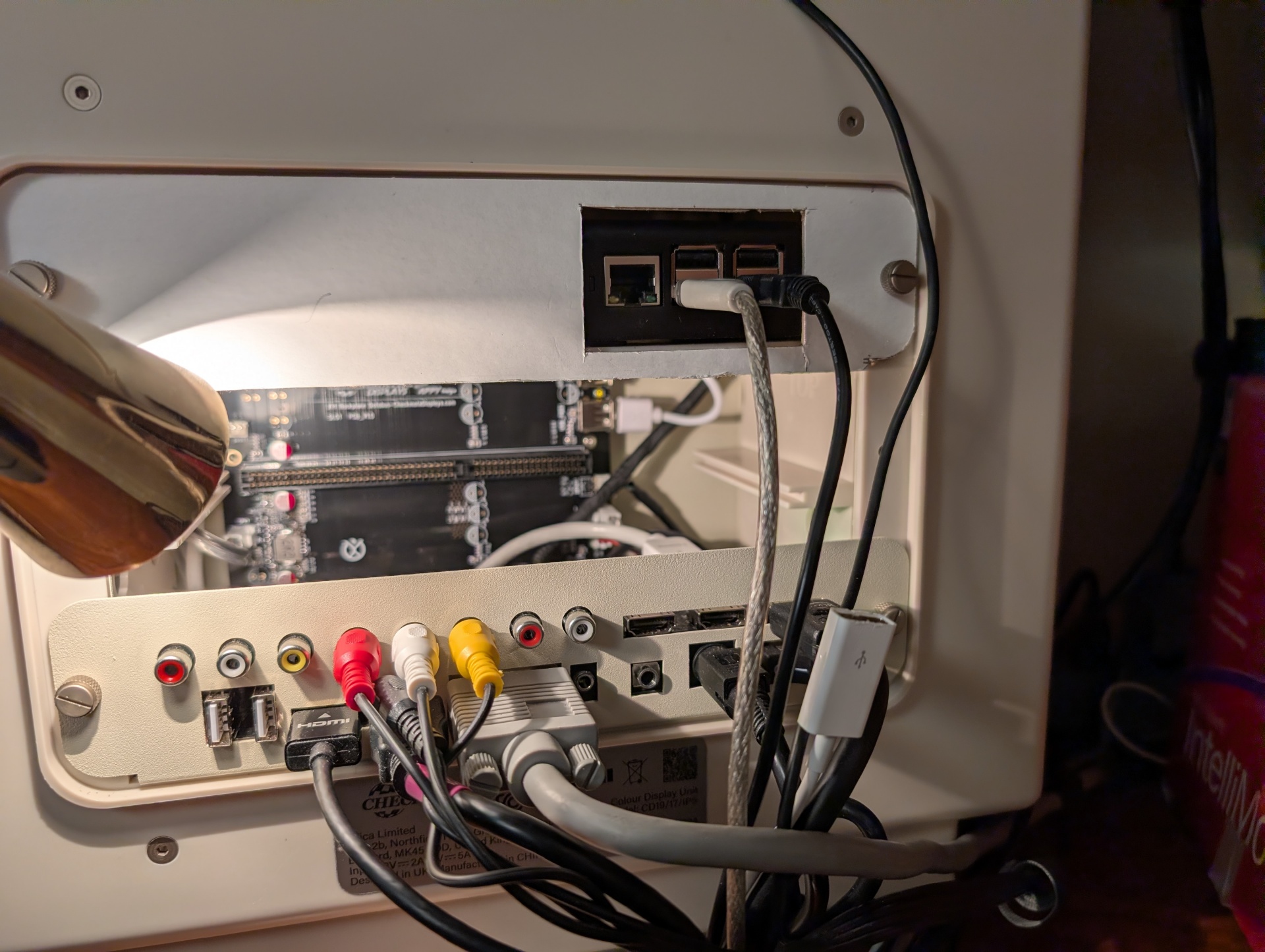
The Checkmate is not just a monitor, it's also an integrated electronics project box, 2u mini-rack and hacking platform.
Basically as I said I ran into one or two semi-issues. The 15Khz horizontal scan rate thing on the VGA port was a real bummer and sent me down a hole, but the OSSC Pro worked out great to help solve that, even though I really don't understand that thing at all. It looked like shit for like a month and just through random button-mashing I got it to work great for both mono and color on the ST. Thanks to CTRL-ALT-Rees for the in-depth review of the OSSC vs RetroTink video specific to the Atari ST platform. If I ever get up the courage to do a factory reset on the OSSC I'll try and document exactly what settings need to be twiddled to make this work in my case.
Thanks again also to BackOfficeShow for leading me to the realization that converting ST to VGA was all just a simple passive "hook the wires to the other wires" process which inspired me to do my Monitor Master hack!
Future projects and other use cases
I do want to see if I can hack a GoTek in there to use as a drive on my ST with the rotary encoder in the monitor. That would be about the slickest thing imaginable. I'll probably get a GoTek with an encoder and try to remove that one and use the monitor one instead.
There are 12VDC headers on the backplane board. Can I wangle one to a barrel jack and mount an 8 port switch in here? I have a couple of 12v@1A Netgear GS108T switches and I'd love to see if I can pull that much power and have a little self-contained network. This is pointless. The Pi in there is just on WiFi, but I kinda want to see.
My most recent job ships cases and cases of hardware to healthcare trade shows. Much of the network hardware for the booth and even small PCs for running demos could easily be securely fitted into a Checkmate with the HDMI out going off to a big TV.
Portable industrial control and automation platform as a self contained control station again with several SBCs and integrated network switching
I'm a network and datacenter-ops guy who naturally looks at everything through that lens. If I were building a crash cart or repair workbench I'd love these just to fill with low power SBCs (Pi 3 works great) and switching for a portable KVM, isolation network and test suite.
While they're not "cheap" for a consumer product, thinking in terms of even small-scale datacenter hardware they're an absolute /steal/.
Other Quirks
I did run into a race issue with the Raspberry Pi as well. I think it takes a bit for the monitor to be fully up and ready to receive video as it starts up. At first I thought it might have been an inrush current type thing, but I think it's just that the monitor isn't "up" yet when the Pi starts shooting out video.
When I'd boot the monitor cold there would be no video until I unplugged and re-plugged power to the Pi. To fix that I added a 10000ms delay to /boot/config.txt and it works great:
boot_delay_ms=10000
To give you a sense of the depth of my personal psychosis, the other issue I kind of have is a ridiculous future-proofing one that is bonkers to even be worried about. There are 6 HDMI inputs on this monitor, but only the main one is directly addressable through the front-panel buttons. Using the front panel, you can switch between HDMI-1 and one of HDMI-2 through HDMI-6. To select between HDMI-2 -> 6 you must use the remote. You can kind of see me do this in the video.
From what I can figure out this of course makes total sense. The UI firmware of the panel, like the off-the-shelf stuff that is the same as the EYOYO monitors, knows nothing about the riser card with all those extra ports on it right? The firmware knows about two ports. The external HDMI-1, and an Internal HDMI that the mezzanine card plugs into, and can select between them. The remote therefore isn't interacting with that COTS firmware to do this, but instead it's controlling the mezzanine card to switch the input among the other 5 ports, which is a very neat way to work around that. I mean obviously the firmware can select the riser card ports, because that's where the composite inputs live as well. If I had to guess it "only" had code to handle two HDMI inputs, so this workaround was implemented.
That's obviously a totally rational way to do this, and really the only way you probably can. It's awesome. My "planner" brain is just saying well, what about in 30 years when that remote is dead or lost. How do I select those ports?
For all I know I can control that mezzanine card totally in code over GPIO from a Raspberry Pi, or serial, or LIRC (which this probably is). Who knows. That's Future Guy's problem. I haven't even dug into that, but I certainly intend to! I want to see just how far I can push this.
Greetz and Links
Checkmate1500plus.com for making an excellent project out of total engineering passion. Excellent work all around to Steve and Appy and the rest of the team!
BackOfficeShow.com for showing how easy it can be to convert ST to VGA and switch between mono and color.